
This article was originally published in Rhythms magazine (March-April 2026, Issue #334)
History Does Repeat! - Split Enz to tour again
By Ian McFarlane
By the time you read this, legendary New Zealand band Split Enz will have stepped onto the stage for their first concert since 2009. On Friday 27 February they’re due to headline the opening night of the Electric Avenue festival, at Hagley Park, Christchurch. It’s a prestigious honour for the veteran band, proving that promoters acknowledge that stellar performers such as the Enz know how to entertain and engage an audience, know how to write songs that inspire on an emotional level and will always leave fans wanting more.
That 2009 concert was when they reformed specifically for Sound Relief at the Melbourne Cricket Ground, alongside the likewise reformed Midnight Oil and Hunters & Collectors. Now that the beast has leapt back into life, they are due to start their Forever Enz Tour, confirmed for May 2026. Enz mainstays Tim Finn, Eddie Rayner, Neil Finn and Noel Crombie have been joined by the young rhythm section of Matt Eccles (drums) and James Milne (bass). There are currently six dates booked, including another headlining slot, this time at Byron Bay Bluesfest 2026. (Ed. Note: As we now know, Bluesfest has been cancelled and the operating company has gone into liquidation.)
When I connected with the Finn brothers for a productive Zoom session, I asked Tim what’s been the impetus this time for touring?
“Being invited to play the festival in Christchurch, that got us out of the cave; that was the trigger,” he replies enthusiastically. “We’re all still active. Neil does a lot of work with Crowded House, obviously, and other projects. I do other projects and Eddie’s always busy. Being so busy, it just needed us all to feel the same way at the same time. Then having agreed to do that, we realized that the interesting and stimulating thing to do was to do a run of shows. We’ve got a new, young rhythm section and I can’t wait to play these songs with them, to get inside them. They’re songs that they knew when they were kids.
“We’ve known them for a long time. In the case of Matt the drummer, we’ve known him since he was a boy. James is a friend of Neil’s son Liam, and so they’re sort of family. Once they got going in rehearsals, and Eddie started playing his keyboards and Noel was doing his percussion thing… Neil found the very amp that he used to play in the 1980s. Everything just sounded so good and tight, very high energy. The set we’re going to play is very high energy. There’s a couple of slower songs, but it’s a lot of up tempo.”
I asked, maybe naively, do you still get a kick out of playing them?
“Oh, definitely,” Tim confirms. “When we started playing ‘Nobody Takes Me Seriously’, I’m just off, you know. Oh, boy! And I’m sure it’s the same for Neil with his songs. You know, they’re great to play.”
Is there anything else audiences can expect to see? Is it just going to be the tried and trusted Split Enz we all love?
“I think we’re going to try and build the show,” Neil says. “Particularly on the tour when we’ll have a longer set. It will enable us to bring out a few deep cuts from the early days. We’ve already got a good selection of stuff we’ve rehearsed. It all sounds really good and suits this line-up. We’ll be putting our full energy into it. I don’t think it’ll feel like, you know, a rote run through. It’s going to feel like it’s got life and vitality.”
“And we’ll have new suits!” Tim reveals. “Noel is making them as we speak, down in Melbourne, with his wife Sally. He’s shown us his designs. His drawings look amazing.”
Noel has always handled the presentation and look of the band, so it’s almost like a Vogue creation in a way. That old style of doing the patterns and then creating the suits.
“Totally old style, yeah,” says Tim. “His drawings are really worth seeing alone,” Neil echoes.
Are we likely to see Noel’s artwork presented for the masses?
“Well, funny you should ask that because there’s going to be a book dedicated to his work,” Tim confirms. “It’s with Allen and Unwin, which is going to be exclusively focusing on Noel and his costumes. I think I’m allowed to say that. It’s long overdue, I think.”
The other vital component of the current Enz trajectory is the remastering and reissuing of the band’s full catalogue. Warner Music Australia have combined with Blue Raincoat (previously Chrysalis Records) to re-present the albums in a series of multi-disc box sets. The band’s catalogue had been well curated in the past – for example, the 9xCD Enz to Enz box (2007); the 1997 best of collection Spellbound (reissued on 2006) – but this is a step up.
The first new vinyl release was ENZyclopedia (Volumes One & Two), containing the band’s debut, Mental Notes (2025 Remaster), second album Second Thoughts (2025 Eddie Rayner Remix) and the rarities collection The Beginning of the Enz (2025 Eddie Rayner Remixes / Remasters). For me, this is a brilliant opening gambit because Mental Notes has always been one of my all-time favourite local albums. (Yes, I know, we Australians love to claim NZ bands as our own, especially when they reach such dizzy heights of success as the Enz have.)
There are actually two box sets, the first containing the three LPs and the second containing five CDs. The CD box adds Second Thoughts (Original Stereo Mix – 2025 Remaster) and Wide Angle Enz (rarities and live). For the dedicated Enz-o-phile, you had to buy both versions. Warners have already announced that the next vinyl box release will combine Second Thoughts (Original Stereo Mix – 2025 Remaster) and Wide Angle Enz (sort of ENZyclopedia Volume 2.5). Another slightly confusing thing is that the rare 1977 single ‘Another Great Divide’ – the last one featuring original member Phil Judd – has been left off this time. But that can be explained by the fact that for the 2006 CD reissue of Dizrythmia (1977), it was added as a bonus track. One must assume it will be present again for the next box set. The reissue programme will progress right through the band’s full career.
That’s the perfect segue into an examination of the band’s history. To quote one of their best known songs, ‘History Never Repeats’; but as we know now, it indeed does repeat.
IT’S HISTORY REPEATING
From early beginnings as an Art Rock ensemble playing all-original, highly arranged material with strange and haunting embellishments, to a sleek and tasteful pop band, Split Enz led a remarkable career. The two central figures in the early days of the Split Enz saga were singer-songwriter Brian Timothy Finn and singer-guitarist-songwriter Philip Raymond Judd. The pair formed Split Ends in October 1972 with the line-up of Jonathan Michael Chunn (bass), Miles Golding (violin) and Mike Howard (flute).
Right from the outset Finn and Judd decided to play concert halls rather than do the usual pub grind. With financial backing from early fan (and soon to be manager) Barry Coburn, Split Ends issued debut single ‘For You’ in April 1973. By the time the single came out Golding and Howard had left. The new Split Ends line-up comprised Finn, Judd and Chunn plus Paul ‘Wally’ Wilkinson (lead guitar) and Geoffrey Chunn (drums). In November 1973 EMI NZ issued the band’s second single, ‘The Sweet Talkin’ Spoon Song’. In early 1974 Finn and Judd changed the band’s name to Split Enz and added Robert Gillies (sax) and Anthony ‘Eddie’ Rayner (keyboards).
Enz fan Geoffrey Noel Crombie began designing the band’s stage costumes and stage props. That allowed Split Enz the luxury of presenting a totally theatrical show, replete with a clutch of refined Finn-Judd compositions with which few other New Zealand bands of the day could hope to compete. In May 1974 Geoff Chunn and Rob Gillies left the band. Paul Emlyn Crowther joined on drums and later in the year Noel Crombie joined the band as art director, occasional vocalist and spoon soloist! In March 1975, the band issued its third single, ‘No Bother to Me’ on the independent White Cloud label.
At the same time Split Enz left New Zealand and headed for Australia. The band swiftly found its feet, scoring support slots to local bands Skyhooks and AC/DC, plus overseas visitors Roxy Music (April), Leo Sayer (May), Lou Reed (July) and Flo and Eddie (July). Tim has been quoted as saying that, when they supported Skyhooks and AC/DC, “half the audience hated us, the other half loved us!”. There were no half measures with this lot. On the other hand, with their support slot to Roxy Music, both frontman Bryan Ferry and guitarist Phil Manzanera professed their admiration. Ferry was quoted as saying, “Split Enz are the best opening act that’s ever played with us”, while Manzanera told the band that if they could get to London, he’d love to produce their next album.
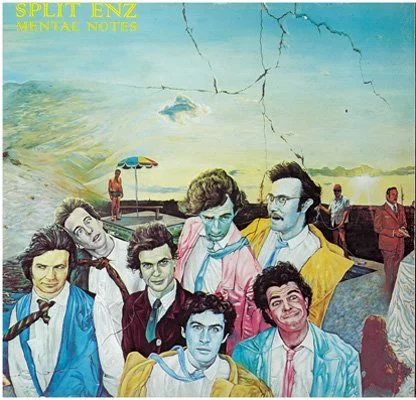
Michael Gudinski signed the band to a management and publishing deal, plus a recording contract with his Mushroom label which resulted in the Mental Notes album (July 1975) and single ‘Maybe’.
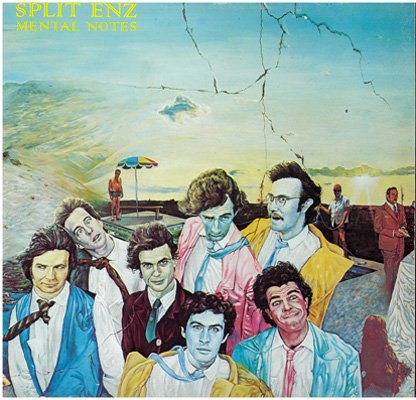
I remember seeing the band on Countdown in all their finery, performing ‘Maybe’. I bought Mental Notes soon after. I was immediately enthralled by this eccentric band and the astonishingly good music I heard.
Mental Notes remains a remarkable album, a genuine 5-star classic, full of skilfully arranged Art Rock, strange and haunting embellishments and otherworldly, Mervyn Peake-inspired lyrics about death and madness (‘Stranger Than Fiction’, ‘Under the Wheel’, ‘Spellbound’, ‘Titus’) all offset by Judd’s disturbing cover artwork. The album tended to confuse some listeners: was it farce or genius? It is theatrical, eccentric, quirky, occasionally twisted... but the playing is never dull, and the arrangements are lush and constantly shifting. It’s heavily keyboard oriented, Rayner contributing piano, organ, Mellotron, synthesizer and clavinet.
Some parallels can be drawn with Peter Gabriel-era Genesis, The Tubes, Sparks etc but that’s only a guide. There is not one dud track. The first three mentioned above are the denser, more sophisticated progressive numbers while opener ‘Walking Down a Road’ has a lighter tone. They get whimsical on the poppier numbers ‘Amy (Darling)’, ‘So Long for Now’ and ‘Maybe’ while Judd’s minor key piano ballad ‘Time for a Change’ is glorious. ‘Titus’ is a baroque dreamscape with mandolin, percussion, tinkling piano, Mellotron strings and Finn’s strangest vocal mannerisms. The final cut, ‘Mental Notes’, is a 0:43 second track that ends with the chant “Make-a mental notes” which repeats until you lift off the needle.
I asked Tim, does the album still hold the magic for him?
“It’s in the memory bank. It can trigger emotions in me still, for sure. And memories. I’m just so glad that the album, and all of our albums in fact, are going to be released as part of this series. It’s been neglected for a long time. And, you know, sadly, we’ve been with labels who haven’t cared for it. When Mushroom was sold on to Warners and big labels like Universal in the States were involved. Chrysalis, which became Blue Raincoat, have been the best. They’re the champions. Blue Raincoat and Warners have come on board here.
“For a long time it was like they didn’t know what they had. They didn’t care. And it’s sad how that can happen to any band. You can just be in the basement, with your multi-track boxes. And unless you’re streaming really well, just by some random piece of luck or sync happens or something miraculous and weird happens, they don’t treasure the heritage. And yet heritage is a big part of how they even exist now. I think 50% of their existence is based on what they call heritage. But anyway, very glad that it’s been looked after at last. Glad you enjoyed it.”
I tell Tim that there’s a lyric line in the song ‘Amy (Darling)’ that’s always puzzled me: is it “She’s a roguentine, she’s a valentine”, or is it “she’s a rogue of time, she’s a valentine”?
“Neither,” he states emphatically. “There wasn’t a lyric sheet with the album, was there? I wasn’t a fan of the lyric sheet, actually. I always thought they’re not poetry. You know, they’re meant to be heard in the song. Of course, we eventually succumbed. She’s… ah that’s a very good question, because they’re Phil’s lyric. Okay, we got the valentine bit. Amy is Phil’s daughter. ‘She’s a real good time’, maybe a real good time. She was a toddler when we were living in England and I used to wheel her around the back garden. I’d put her in the pram and go super-fast around the back lawn. She was a real good time.”
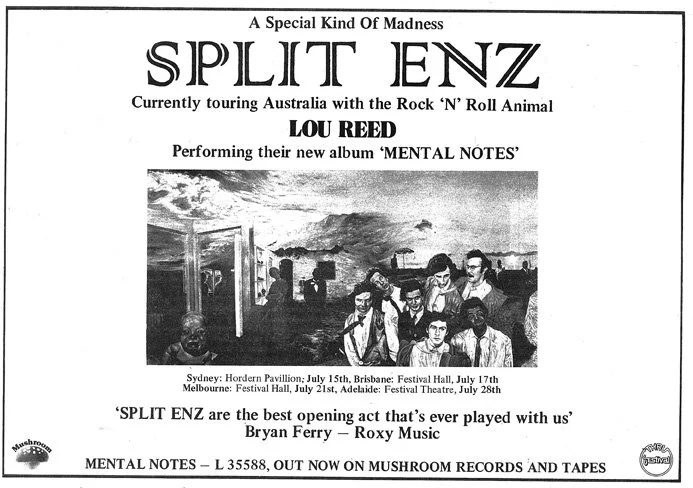
The album sold 12,000 copies in Australia, reaching #35 on the album chart for one week. It also peaked at #7 in New Zealand. At the end of 1975 Robert Gillies (sax, trumpet) returned to replace Wilkinson. In March 1976 Mushroom issued the band’s second single, ‘Late Last Night’. A month later Split Enz flew to London to record the second album with producer Phil Manzanera, at Basing Street Studios. Issued later in the year, Second Thoughts comprised four re-recorded tracks from the debut, a re-recorded ‘Late Last Night’, three new songs plus a re-recording of ‘One Two Nine’ as ‘Matinee Idyll’ (129) and released as a single (December 1976).
The newer compositions, ‘Late Last Night’, ‘Lovey Dovey’, ‘Sweet Dreams’ and ‘The Woman Who Loves You’ maintained the startling originality and catchy theatricality of the debut. With Gillies’ saxophone and trumpet, the sound is even more varied. The band’s overwhelming appearance and on-stage buffoonery merely baffled the UK press and audiences alike at the time but eventually a cult following, calling themselves Frenz of the Enz, began to emerge. Chrysalis issued the album internationally as Mental Notes (September 1976) with the brief title cut added at the end to stamp the connection.
I asked Tim what he remembered most about recording with Phil Manzanera?
“That was an amazing time for us because we had wanted to get to England. When we signed to Mushroom in ‘75 in Sydney, we weren’t that excited. We thought, oh, we don’t really want to sign to an Australian label. We wanted to sign to an English label or an American label. It sounds like we were a bit snobby and pretentious, but we just had big dreams. Anyway, we did sign with Mushroom, and it worked out great. But we said to Michael, ‘we will only sign if you get us to England within 12 months’. I think we might have had that written into the contract.
“Twelve months later he flew us over there and put us up, spent a lot of money. He put in a big investment and got us to London. The trigger for that was that Phil Manzanera had seen us when we supported Roxy Music in Sydney. He said he’d like to work with us and help us make a record. So that all lined up. We played a gig with Gentle Giant down in Southampton. Chrysalis came down, saw it, loved it, signed us. So it was all happening. It was like a dream come true. Red buses, black taxis, we’re in London, we’re making a record, Bob Marley’s down in the basement making Exodus.”
JUST ANOTHER GREAT DIVIDE
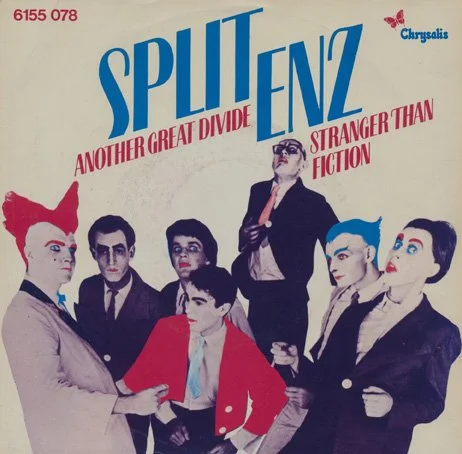
In November Englishman Malcolm Green (ex-Octopus) replaced Crowther on drums. Split Enz returned to Australia and New Zealand in January 1977 for the Courting the Act tour, which coincided with the release of the single ‘Another Great Divide’. Chrysalis issued Mental Notes (Second Thoughts) in the USA and Split Enz embarked on a six-week American tour. As in the UK, American audiences reacted with bemusement rather than acclaim. In April 1977 Tim’s 18 year-old younger brother Neil replaced Judd on guitar and another Englishman, Nigel Griggs (also ex-Octopus), replaced Chunn on bass.
I asked Neil how he reacted when Tim called him from London with the offer of joining the band?
“Well, I was surprised,” he confirms. “I didn’t expect it when it came. I’d never played electric guitar before either, only acoustic. I probably questioned for a moment whether… what, I have to be Phil Judd now? In a sense it did seem quite… I was surprised that Phil had left anyway, that was sudden. And then suddenly Mike Chunn was leaving as well, so it seemed like a pivotal moment. But really it was, you know, amazing to be asked. I just went, oh yeah, I can’t turn an adventure like that down. And so I was giddy with excitement, and three days later I was in London, which is enough of an amazing turn of events for an 18-year-old from New Zealand anyway. To be driven straight to rehearsal with my favourite band, as they were. There was a lot of anticipation, a lot of uncertainty about what I was going to be able to do. But yes, quite an amazing turn of events.”
Neil told the ABC’s 7.30 Report in a recent interview that Tim had, unbeknown to him, rung their mother to get her permission first. As the kid brother, Neil had to come up with a look that fitted the band’s presentation. I’m still intrigued by that tuft of hair on the back of his head, a hair whorl.
“Yeah, the Dennis the Menace tuft. I couldn’t think of anything else. The hairstyles were so well established. I didn’t really think I could venture straight into the mohawk thing, you know, all the wings. They were already well covered. So just one little spike. And I got a pair of glasses with no glass in them. It was my little distinctive look. Somebody thought I looked like that TV puppet character Joe 90.
“Yeah, I just jumped right in. Whatever I lacked in the actual skill on guitar, I made up for in the amount of bouncing around the stage I did. And you know, goofy looks, which now in hindsight when I look back on it, I go, oh, why did I bother? That was a bit embarrassing really, but nobody told me to quieten down. The band were very tolerant. Tim encouraged me to be as good as I could be in that context. But yeah, I was just pulling all the faces that I thought were Split Enz faces and I hadn’t figured out my actual role yet.”
Split Enz began to play to increasing crowds in the UK and in June the band entered London’s Air Studios to record a new album, with producer Geoff Emerick. Issued in August 1977 Dizrythmia (a sly misspelling of the medical term dysrhythmia) reached #18 for one week in Australia while the first single, the dizzy ‘My Mistake’ (August), peaked at #15 during October. The second single, ‘Bold as Brass’ (December), failed to chart. Following an Australasian tour, Dizrythmia reached #3 in New Zealand and ‘My Mistake’ peaked there at #21. Between October 1977 and February 1978 Split Enz toured throughout the UK and Europe. Judd returned for a month in early 1978 (replacing Gillies) before departing for good.
By 1977, the Enz had started to shed the last vestiges of their Art Rock beginnings and Dizrythmia hints at the snappy New Wave gems that were to follow. With Judd’s departure, Tim was able to lead the band’s direction. There’s still plenty of quirkiness and flamboyant theatricality on display, but they were also starting to catch on how to programme a more commercially viable sequence of music. The rollicking, jangly ‘Bold as Brass’, ‘My Mistake’ and ‘Parrot Fashion Love’ comprise a brilliant one-two-three opening punch. The last song Judd wrote for the band, the juddering, glammy ‘Sugar and Spice’, is a quirky delight. ‘Without a Doubt’ slows the mood with its maudlin introspection. The brilliant spell cast by the run of ‘Crosswords’, ‘Charley’ (a Paul McCartney favourite, apparently) and ‘Nice to Know’ on Side 2 is heightened by the progressive headiness of last track ‘Jamboree’.
Split Enz spent most of 1978 without a UK record deal and without a manager. As the debts continued to mount, prospects were grim. The band persevered and entered Manor Studios in November to record a new album with producer Mallory Earl. That same month Mushroom issued the whirlwind rocker ‘I See Red’ as a single in Australia.
‘I See Red’ eventually peaked at #15 during February 1979 by which time Split Enz had returned to live in Australia. The band’s fourth album, Frenzy, charted at #24 and produced the single ‘Give it a Whirl’ (May 1979). One song, ‘She Got Body She Got Soul’, was later reworked for the soundtrack to the feature film Starstruck.
Tim confirms that the band’s move into a more commercial sound was definitely not planned.
“We were creatures of instinct and never made a smart move ever, you know. So when I say that, I mean, obviously we fluked a few very smart moves, but they were just flukes randomly connecting with the zeitgeist or whatever it was.
“With ‘I See Red’, I remember writing that. It was written as a mid-tempo piano song and yet it still had a kind of a pounding quality. It was like I needed to sell that lyric of anger and frustration. But it was definitely not planned. It wasn’t the ‘I See Red’ that people would think of now. What happened was; it was a sleepy afternoon in London. We were all a bit bored, half the band were on the dole. We didn’t have a manager or a record label or anything. We’d been stripped bare. We’d lost everything. And we were rehearsing nevertheless and enjoying our playing, but it was so hot. We had no energy. And playing the song in a mid-tempo sort of way made it really boring for all of us.
“I said, ‘let’s just play this as fast as we’re physically able to play it’. We did that, and it was galvanizing. It seemed like the band had this huge rush of energy because we were all able to express our frustration and disappointment and anger, in a way, at how it ended up. Because 12 months prior, everything had been so sweet, you know, all the dots connected. And then we had it all taken away. It’s partly our own fault. I don’t know, it was chaos. And so that song allowed us to transcend that. And then that led eventually to that True Colours period. We were playing a lot of bars and clubs and smaller venues. Years before, we tried to use Mellotron and real piano on stage, and those things were just long gone. We wanted to punch harder and connect with the people in all rooms.”
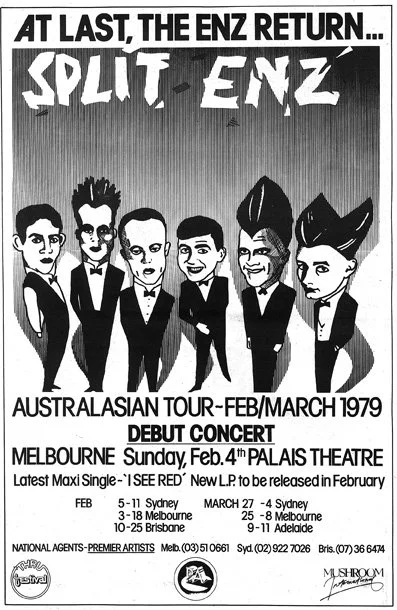
With their return to Australia, the band set off on an extensive Australasian tour throughout February and March 1979. I tell Tim and Neil that I saw the band twice on that tour, firstly at the Palais Theatre and secondly at one of Melbourne’s regular suburban beer barns, the Village Green Hotel, Mulgrave. There was a low stage, and I managed to secure a spot about two feet in front of Tim’s microphone stand. When I relate that anecdote to Tim, he nearly chokes on his words.
“Yeah, that was summer and it was really hot and sweaty. I didn’t like it. I much prefer a theatre show where there’s a distance and you can hardly see anyone and it’s like you’re playing out to the crowd, but you’re not confronted with them that close. I got used to it.”
“It was particularly you at that show, actually, that he didn’t like. He remembers you,” Neil chips in with a big grin on his face. Tim continues, without missing a beat, “I used to close my eyes a lot. A lot of singers do. I’ve noticed that on clips. It’s quite a common thing to close your eyes, but I definitely close mine a lot.”
Neil goes on to explain further, “I would say that when we came back from the UK, that tour was quite a revelation. We actually made a bit of money when ‘I See Red’ came out. We started to gather a live audience. So in a way, it was pretty useful for us at the time.”
Tim says, “Michael Gudinski said to us, ‘why don’t you come back to Australia?’. That was a good call because he knew there was an audience waiting to see us. And as much as it was sweaty and confrontational, that period was definitely the making of the band.”
The self-produced single ‘Things’ (October) failed to chart. Everything, however, was about to explode for the band. Their fifth album, True Colours, was delightfully commercial, full of contagious songs, crackerjack melodies, sweet vocals and bright instrumentation (and no strangeness!). It marked the arrival of Neil as a major songwriter; his snappy, radio friendly pop masterpiece ‘I Got You’ was an unqualified success. Legend has it that Gudinski declared that he didn’t hear a hit single on the record. He had shown great faith in letting the band develop over a lengthy period, and across five albums, but he was looking at the balance sheets and the figures were not encouraging.
As it turned out, he shouldn’t have been so concerned. Produced by Englishman David Tickle, True Colours and ‘I Got You’ (January 1980) simultaneously topped charts in both Australia and New Zealand during March. In Australia, the album remained at the top for ten weeks, the single for eight. ‘I Got You’ went on to become the highest selling single in Australia for the year. The Enz set off on the Sporting True Colours national tour through March-April, co-headlining with fellow Mushroom stars The Sports, promoting their album Suddenly!.
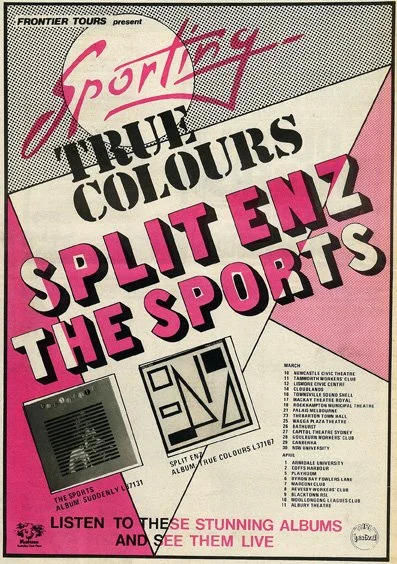
As well as the brilliant music contained within, True Colours featured a striking geometric cover design. Then backed by a voracious marketing campaign (different coloured jackets for each new pressing, the laser-etched edition, the video album etc.), it went on to sell over 350,000 copies in Australia. A&M issued it in the UK, Canada and the USA. ‘I Got You’ reached #12 on the UK charts during August and True Colours #38. ‘Poor Boy’ was also a radio hit in the UK. In Canada, the album made it to #10. The next single, Tim’s emotional ballad ‘I Hope I Never’ (May), reached #18 on the Australian charts. For the first time, the band was debt free.
Corroboree continued the winning streak. Another Australian and New Zealand #1 (over 210,000 copies sold here), it produced the Neil Finn-penned singles ‘One Step Ahead’ (#5 in November 1980) and ‘History Never Repeats’ (#4 in April 1981). The album’s third single, ‘I Don’t Wanna Dance’ (June), failed to chart. Corroboree came out as Waiata (Maori for “a gathering for a tribal dance”) overseas. ‘History Never Repeats’ made #63 in the UK during May. By that stage Crombie had taken over as drummer from Green and the band took off on a world tour.
BEATS & CREATURES & LEAKY BOATS
In the meantime, former Split Enz co-founder Phil Judd had launched his new band, The Swingers, and signed to Mushroom. The band’s classic #1 single, ‘Counting the Beat’ (January 1981), became the fastest selling local single since Daddy Cool’s ‘Eagle Rock’ a decade earlier.
Produced by Englishman Hugh Padgham, Time and Tide (April 1982) became Split Enz’s third successive #1 album in Australia (over 140,000 copies sold) and New Zealand (and #4 in Canada). As possibly the band’s finest achievement, Tim’s highly personalised songs dominated at the expense of Neil’s more upbeat tracks. The unsettling ‘Dirty Creature’ (#6 in April), the remarkable ‘Six Months in a Leaky Boat’ (#2 in June) and the reflective ‘Never Ceases to Amaze Me’ (August) were all issued as singles.
Split Enz’s UK career virtually came to a standstill when radio stations refused to play ‘Six Months in a Leaky Boat’, due to supposed negative references to the Falklands War. The Best Of collection Enz of an Era made #8 in Australia (December) and #1 in New Zealand, selling 30,000 copies there. In June 1983 Tim issued a solo album, Escapade and single ‘Fraction Too Much Friction’, and won Best Songwriter at the TV Week/Countdown Awards. Split Enz also won the Best Album (Time and Tide) and Most Popular Group awards.
The Split Enz single ‘Next Exit’ (March) came out as a stop-gap measure until the band could record a new album. Conflicting Emotions (November 1983) was a relative failure, reaching #13 on the national chart in January 1984 (50,000 copies sold). Still, the band’s solid playing and ethereal melodies remained intact, giving the music a palpable sense of unity and purpose. Neil’s songs ‘Strait Old Line’ (October 1983; #31), the haunting ‘Message to My Girl’ (January 1984; #12) and ‘I Wake Up Every Night’ (April 1984) appeared as singles.
For the Conflicting Emotions tour, Paul Hester (ex-Deckchairs Overboard) joined on drums and Crombie returned to his percussion role. In June 1984, Tim finally ended months of speculation and left the band in order to promote the release of Escapade in Europe. The remaining members recorded See Ya ’Round as a final studio album (issued November 1984; #29). Once again Neil’s songs dominated proceedings, with ‘I Walk Away’ (September) and ‘One Mouth is Fed’ (November) appearing as singles.
Having decided to end the band, Split Enz (with Tim on board) embarked on the Enz with a Bang Australasian tour throughout October/November 1984. Split Enz played its last show on 4 December in Auckland, bringing an end to the career of New Zealand’s most famous group. The live shows produced the double album The Living Enz (December 1985).
By that stage Neil and Paul had launched their new band, The Mullanes (soon to be Crowded House), and Tim was back on the solo trail. There have been Split Enz reformations over the years, including a 1989 Australian tour, a one-off 1992 show in Sydney for the NZ Tourist Commission and an Australasian tour in 1993 (which resulted in the live album Anniversary). Meanwhile, Rayner did session work and formed The Makers. In 1987, Judd, Crombie and Griggs formed Schnell Fenster.
Interest in Split Enz remained high and, in 1994, Rayner began work on the Enzso project which featured orchestral arrangements of 17 Split Enz songs. He chose the darker, moodier numbers like ‘Stranger than Fiction’, ‘Stuff and Nonsense’ and ‘I Hope I Never’ at the expense of the obvious pop hits like ‘I Got You’. Rayner recorded the songs with the New Zealand Symphony Orchestra in December 1995. Neil sang ‘Message to My Girl’, New Zealand chanteuse Annie Crummer sang ‘I Hope I Never’. The Enzso album made its debut at #4 on the Australian chart in July 1996. It attained Platinum status (70,000 copies sold) after ten weeks, remaining in the Top 40 for 15 weeks. Enzso re-entered the national Top 40 in February 1997 when Eddie, Tim, Neil and Noel undertook the Australian Enzso tour backed by the Adelaide Symphony Orchestra.
While Tim and Neil continued to enjoy worldwide success with various projects, interest in Split Enz has remained strong. The group was inducted into the ARIA Hall of Fame in 2005. The albums were remastered and reissued in 2006. Spellbound The Very Best Of Split Enz, which had originally come out in 1997, gained a new lease on life when it reached #5 in June 2006 (over 70,000 copies sold). Then on 14 March 2009 Split Enz reformed for a one-off appearance at the massive Sound Relief concert (at the MCG), a benefit for victims of Victoria’s Black Saturday bushfires. In tandem with the Sydney concert at the SCG, the event was described as “a simultaneous celebration of music and the human spirit”.
Which now brings us up to date with the new tour and reissue programme. To round out this thorough examination, I’ve picked a baker’s dozen of Split Enz songs – some classics and deep cuts – which I see as representative of the band’s authoritative songwriting skills.
Stranger Than Fiction (T. Finn-P. Judd; Mental Notes)
Amy (Darling) (T. Finn-P. Judd; Mental Notes)
Late Last Night (P. Judd; Second Thoughts)
Another Great Divide (Judd-Finn-Rayner; Single)
Sugar and Spice (P. Judd; Dizrythmia)
I See Red (T. Finn; Single; Frenzy)
The Roughest Toughest Game in the World (T. Finn; Frenzy)
I Got You (N. Finn; True Colours)
Nobody Takes Me Seriously (T. Finn; True Colours)
History Never Repeats (N. Finn; Corroboree)
Dirty Creature (Finn-Griggs-Finn; Time and Tide)
Six Months in a Leaky Boat (T. Finn-Split Enz; Time and Tide)
Message to My Girl (N. Finn; Conflicting Emotions)
DISCOGRAPHY
Mental Notes (Mushroom, 1975), Second Thoughts (Mushroom, 1976), Dizrythmia (Mushroom, 1977), Frenzy (Mushroom, 1979), The Beginning of the Enz (compilation, Mushroom, 1979), True Colours (Mushroom, 1980), Corroboree (Mushroom, 1981), Enz of an Era (compilation, Mushroom, 1982), Time and Tide (Mushroom, 1982), Conflicting Emotions (Mushroom, 1983), See Ya ’Round (Mushroom, 1984), The Living Enz (Live) (Mushroom, 1985), The Best Of Split Enz History Never Repeats (compilation, Mushroom, 1989), The Split Enz Collection 1973-1984 (compilation, Concept, 1989), Box Set 1972-1979 (seven CDs including Odds and Enz rarities collection, Mushroom, 1993), Box Set 1980-1984 (six CDs including sundries collection Rear Enz, Mushroom, 1993), Anniversary (Live) (Mushroom, 1994), Enzso (Epic, 1996), Spellbound The Very Best Of Split Enz (compilation, Mushroom, 1997, reissue 2006), Other Enz: Split Enz and Beyond (Various Artists) (compilation, Raven, 1999), Greatest Hits Live (Liberation, 2005), The Rootin Tootin Luton Tapes (archival, Warner, 2007), Enz to Enz (Box set) (Warner Mushroom, 2007), Live, Alive Oh (Liberation, 2017), Enzyclopedia (Volumes One and Two) (Chrysalis, 2025)